Scammers borrow the names of real insurance agencies and advisors, and regulators tell clients to verify. Why independent agencies and wealth advisors should tell clients, before it matters, how they will and will not make contact, with an invented example.
On Monday, Engadget ran a plain explainer on why scammers try to keep people on the phone. The caller claims to be from your bank, says your money is at risk, and asks you not to hang up. Once you stay on the line, the pressure builds, and the next step is a verification code or a transfer. It also described a spoofed call, in a case the FBI reported in August, where a fake number looked like a real government office. Caller ID proves very little.
Your clients are getting these calls. Some of them will get one that says it is from you.
A 63-second animated explainer on telling clients, before it matters, how an independent insurance agency or wealth advisory firm will contact them, what it will never ask for and how to check.
Open video in a new tabRead the video transcript
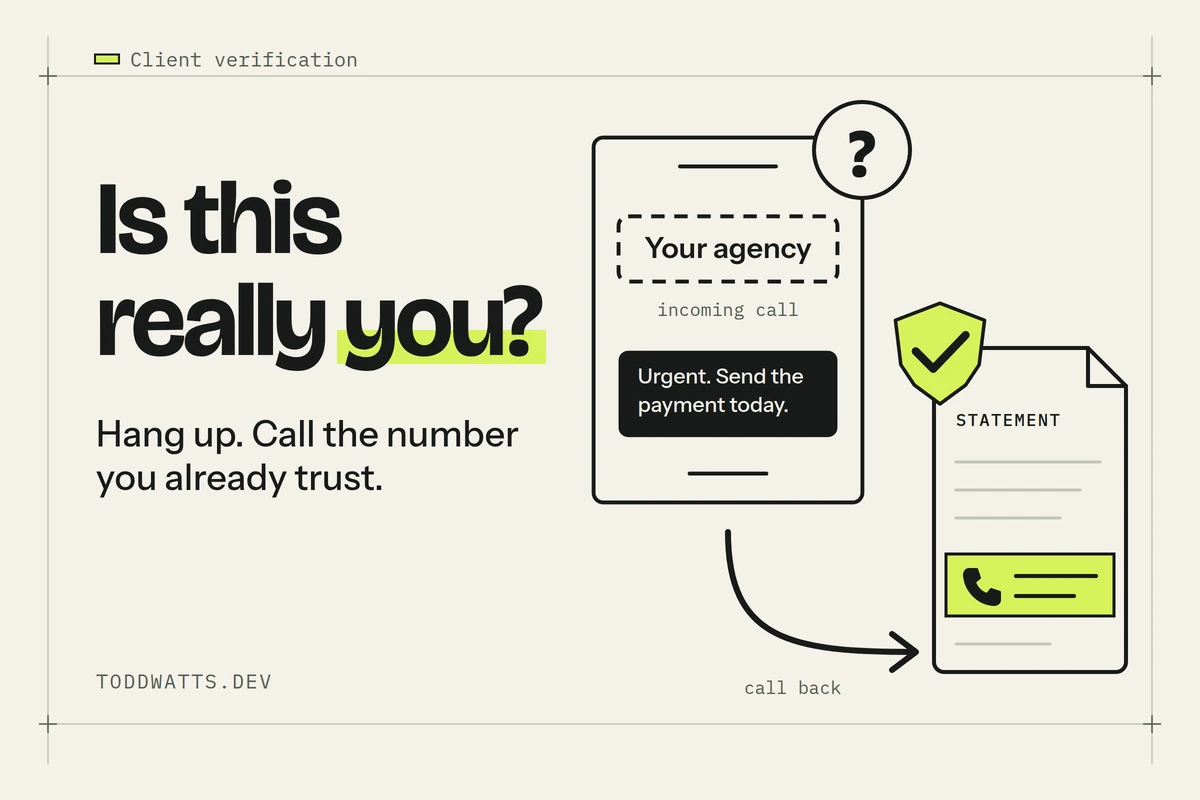
Scammers are calling your clients right now. They pretend to be a bank, sometimes your agent or advisor. They keep people talking and make everything feel urgent. The number on the screen proves almost nothing. Regulators give clients one rule. Hang up, and call back on a number you already trust. But clients need to know which number is yours. Many have never been told. Tell clients before it matters. How we contact you. What we never ask for. How to check, with a number they already have. Then say it again, every year. Here's an invented example. We reach you by office line, firm email or portal. We never ask for a password or a code. We never ask you to pay a person or move money on a call. If it feels off, hang up and call the number on your statement. Agencies, print one payment rule on every invoice. Advisors, agree how a transfer gets confirmed. Technology is the means. Clear communication is the value.
They borrow your name
Regulators say this directly. FINRA warns that in investment imposter schemes, scammers misuse the names of real, registered professionals and firms, and in most cases the real professional does not know it is happening. The SEC's investor alert tells people not to rely on contact details the caller supplies, and to be suspicious of encrypted messaging apps or an email address that does not match the firm. The Connecticut Insurance Department put out a consumer notice on May 15, 2026 about fake emails and texts that claim a balance is overdue and push people to act at once.
Notice what that advice leaves out. It tells your client to verify you. It does not tell your client how. If you have never told them which number is yours, which channels you use and what you will never ask for, they have nothing to check against. A scammer's confident voice is up against a client's vague memory of how you usually reach out.
Make the real thing easy to recognize
The fix is not a new system. It is one clear, repeated message that you send before anyone needs it:
- How we contact you. Name the channels you actually use: your office line, your firm email domain, your client portal. If you do not text clients, say so.
- What we will never ask for. A password, a one-time code, a payment to a person or a gift card, or a move of money to a "safer" account because of a phone call.
- How to check. If anything feels off, hang up and call us at the number printed on your statement or on this page. We would rather take a thousand "was this you?" calls than one real loss.
Put it where clients already look: the welcome packet, the bottom of invoices and renewal notices, the first line of your voicemail greeting, and your email signature. Say it again each year in the year-end note.
At an agency
Premium payment is the usual target, because "your policy will lapse today" is a believable sentence. Print one rule on every invoice and renewal notice: we only take payments through this portal or this phone line, and we never ask a client to pay a person directly. Train your service team to answer "is this real?" calls with thanks, not impatience. Carriers will have their own payment rules, so match them.
At an advisory firm
The sharpest risk is a request to move money. Agree with each client, once, how a transfer gets confirmed: a call-back to the number already on file, and a short word or phrase if you both like. Say plainly that you will not ask for credentials by email or text. The SEC's guidance also makes a point worth copying: someone who refuses to get on a call or meet is a red flag, so offer a call every time you ask for something unusual.
An invented example
This is an invented example of a short notice a firm could add to its welcome packet. The firm and the details are made up.
We will contact you by phone from our office line, by email from our firm address, or through your portal. We will never ask for a password or a code, and we will never ask you to pay a person or move money because of a call. If something feels off, hang up and call the number on your statement. We would rather you check.
What this does not do
This will not stop a determined criminal, and I have no data showing that a notice lowers fraud at independent firms. The sources describe the scam patterns and the advice; they do not measure what firms can do about them. Your compliance, carrier and custodian rules come first, and some firms will need approved wording. Nothing here is legal advice. If you learn someone is using your name, tell your regulator and your clients quickly.
My take
Fraud is a communication problem before it is a security problem. The scammer's whole advantage is that the client has never been told what the real you sounds like. The fix is cheap, and it is also good service: tell clients how you will reach them, what you will never ask for and how to check, and say it more than once. A client who knows your habits can spot a stranger in seconds, and a firm that makes itself easy to verify earns more trust on every ordinary call, too. The tools for sending and filtering messages are everywhere. Being clear enough that your client can tell it is you is the value.
Sources
- Engadget, "Why scammers try to keep you on the phone (and how to spot their tactics)" (Nov 16, 2026): https://www.engadget.com/2314524/why-scammers-keep-you-on-phone/
- FINRA, "Be Alert to Signs of Imposter Investment Scams": https://www.finra.org/investors/insights/be-alert-signs-imposter-investment-scams
- SEC Office of Investor Education and Advocacy, "Beware of Fraudsters Impersonating Investment Professionals and Firms" (Investor.gov alert): https://www.investor.gov/introduction-investing/general-resources/news-alerts/alerts-bulletins/investor-alerts/beware-fraudsters-impersonating-investment-professionals-and-firms-investor-alert
- Connecticut Insurance Department, Consumer Notice (May 15, 2026): https://portal.ct.gov/cid/consumer-information-center/consumer-alerts/2026-consumer-alerts/notice-2026-05-15

Todd Watts
Software engineer and fractional CTO through Shell Command, LLC. Technical direction, architecture and hands-on development.